

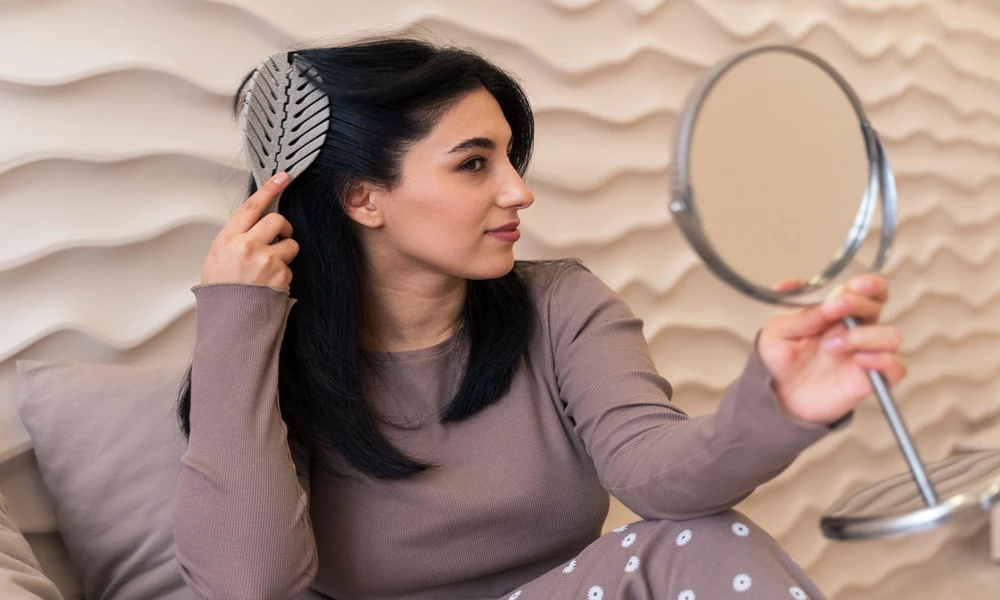
The same haircut can look noticeably different from one person to the next, largely because of factors that go well beyond the style itself. Understanding how to fix flat hair often starts with identifying which specific factors are actually contributing to the flatness in the first place.
Hair Texture and Its Natural Tendency Toward Flatness
Hair texture plays a significant role in how naturally full or flat a straight style appears.
- Fine hair strands generally have less natural body, making flatness more likely without added support.
- Hair density, or how many strands grow per area of scalp, affects how full a style can appear overall.
- Naturally straight hair tends to lie closer to the scalp compared with wavier textures, reducing visible lift.
Product Buildup and Its Effect on Volume
Product residue can quietly weigh hair down over time, even when styling products are used with good intentions.
- Heavy conditioners or oils applied too close to the roots, which can flatten hair at the source.
- Residue from styling products that accumulates gradually without regular clarifying washes.
- Overuse of leave-in treatments, particularly on fine hair that doesn’t need much additional product.
Cutting Technique and How It Shapes Fullness
The way hair is cut has a direct effect on how it falls and how full it appears once styled.
- Blunt cuts can sometimes emphasise flatness, particularly on hair that’s already fine or thin.
- Layering techniques can add the appearance of movement and volume, depending on where layers are placed.
- Cutting hair at an inappropriate length for its texture can unintentionally weigh it down further.
Styling Habits That Contribute to Flatness
Everyday styling choices, even small ones, can accumulate into a noticeably flatter overall look.
- Brushing hair excessively after styling, which can smooth away volume that was built in earlier.
- Sleeping on hair without any protective or volumising routine, flattening it overnight.
- Skipping root-lifting techniques during blow-drying, leaving hair closer to the scalp than necessary.
Comparing What Causes Flatness With What Supports Fullness
| Factor | Contributes to Flatness | Supports Fullness |
|---|---|---|
| Product use | Heavy products applied at the roots | Lightweight, root-lifting products |
| Cutting technique | Blunt, uniform lengths | Strategic layering |
| Styling routine | Excessive brushing after styling | Root-focused blow-drying technique |
| Hair care habits | Unprotected sleeping patterns | Volumising overnight routines |
This comparison reflects general tendencies, since results can vary depending on individual hair texture and density.
Practical Adjustments Worth Trying
A few practical changes can help address flatness without requiring a complete change in routine.
- Switching to lightweight, root-lifting products designed specifically for fine or flat-prone hair.
- Asking a stylist about layering options suited to your specific hair density and texture.
- Adjusting blow-drying technique to focus on lifting hair at the roots before smoothing the lengths.
- Reducing product application near the scalp, reserving heavier products for the mid-lengths and ends only.
Scalp Health and Its Often-Overlooked Role
The condition of the scalp itself is frequently overlooked when troubleshooting flatness, even though it plays a meaningful part.
- Excess oil production at the scalp can weigh hair down at the roots more quickly than expected.
- Product buildup on the scalp can clog hair follicles and affect how hair sits once styled.
- Poor scalp circulation may contribute to finer, weaker hair growth over time, compounding flatness.
- Regular scalp cleansing and occasional exfoliation can help maintain a healthier base for volume to build from.
When Styling Adjustments Aren’t Enough
Sometimes flatness is deeply tied to the hair’s underlying texture rather than something a change in routine can fully resolve on its own. In these cases, a more structural approach, such as volume rebonding in Singapore, may be worth discussing with a stylist to achieve lasting fullness rather than relying solely on daily styling adjustments.
Wondering why your straight hairstyle keeps falling flat? Ask our stylist to assess your texture, cut and styling routine to pinpoint exactly what’s causing it.
